


IWRM in Pacifi c Island Countries
Integrated
Water Resources
Management
The Pacifi c Island Countries have
(IWRM)
started working at different stages
How are we doing?
of the IWRM process, whether it is
Considers all the
revising policy and legislation, forming
IWRM component
CI FSM FJ KI RMI NR NI PA PNG SA SI TO TV VA
interactions of water with
a water coordination committee,
Intersectoral water coordination body
nature and humans, along
developing a Water Safety Plan,
National water resources policy
its route from raindrop to
creating water protection areas or
ocean
Overarching water resources legislation
catchment management committees,
IWRM Plan/Strategy
raising awareness on water and
The Pacifi c Integrated
Recognises water as
Water Use Effi ciency Plan
health,
promoting
sustainable
a fi nite and vulnerable
alternatives for sanitation and
resource with an
Not existing
Draft/interim not formally adopted, functions outlined, fully intersectoral or proactive
wastewater, setting up hydrological
Water Resources
economic value
Formally adopted, fully intersectoral and active
monitoring programmes, or looking
Works towards balancing
at economic effi ciency of water
CI - Cook Islands, FSM - Federated States of Micronesia, FJ - Fiji, KI - Kiribati, RMI - Republic of Marshall Islands, NR - Nauru,
use. The EU-funded IWRM National
NI - Niue, PA - Palau, PNG - Papua New Guinea, SA - Samoa, SI - Solomon Islands, TO - Tonga, TV - Tuvalu, VA - Vanuatu
Management Programme
water demands for
environment, human
Planning Programme will support the
health and economic
different countries based on their
development, to ensure
specifi c situation and needs.
optimal, equitable and
sustainable use
Brings together
stakeholders from different
Challenges and opportunities for Water Governance
sectors and social groups,
to plan and manage water
Kiribati, Fiji and the Solomon Islands were chosen to pilot governance processes for intergrated and sustainable water management with support
in a coordinated, gender
from the regional Programme for Water Governance (PfWG) funded through the European Union (2005-2007).
balanced and participatory
The programme helped the three countries to initiate a process for effective water governance.
manner
Through the PfWG process, Fiji developed a draft water policy and a draft Water Resources Act.
Fiji also formed a National Water Committee and formulated a draft strategy to support the
IWRM process. The Cabinet has since adopted the draft Policy as Interim, subject to an ongoing
consultation process. The future IWRM process in Fiji will need to raise awareness and under-
standing of IWRM to ensure political commitment to dealing with complex issues such as water
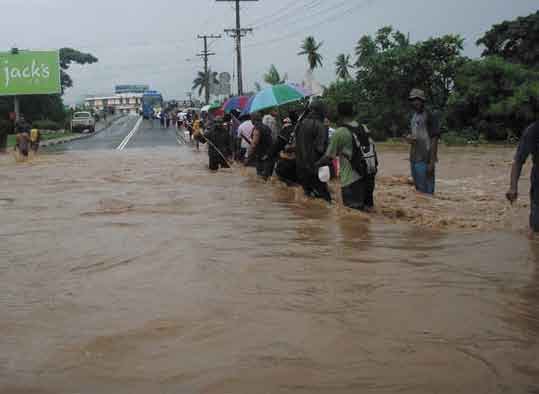
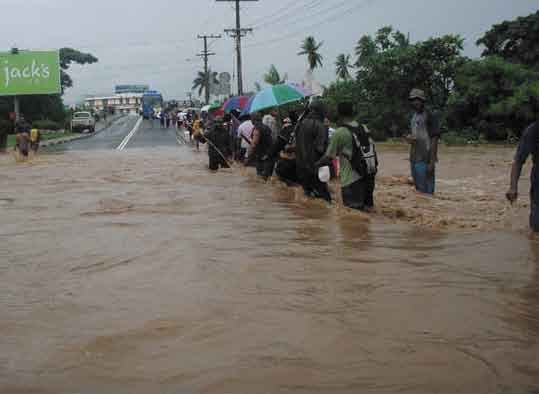
ownership. There is a risk that urgent issues such as fl ooding and access to water supplies will
`take over' overarching policy processes, resulting in a disjointed and fragmented approach to
the resource and its management, and a lack of attention to the interconnected nature of land
and water.
Fiji
The Solomon Islands has faced periods of political instability, which has made it diffi cult to focus
government attention on a single issue such as water. Water resources management has been
fragmented due to a lack of national policy and community awareness. Through the PfWG, key
government representatives got the chance to exchange experiences with Samoa, which has already
come far in the process of improving water governance. Solomon Islands drafted a National Water
Resources Policy and a National Water Resources Legislation, formed a temporary water group
and drafted terms of reference for a National Steering Committee to support the IWRM process.
The government has provided a budget allocation for the IWRM process and are currently focusing
on consultation and review of the National Water Resources Act. Solomon Islands are faced with
challenges such as resolving water ownership issues (especially in the view of increased mining
What? The Pacifi c Integrated Water Resources Management (IWRM) Programme will assist Pacifi c Island
activities) and raising awareness of water resources management (specifi cally links to land-use
practices) taking into account low literacy rates in communities.
Solomons
Countries to establish and implement effective IWRM and Water Use Effi ciency (WUE) plans based on best
practices and demonstrations.
It consists of two main projects: 1) The EU funded "IWRM National Planning Programme" and 2) the GEF
funded "Sustainable Integrated Water Resources and Wastewater Management Project in Pacifi c Island
The main challenges to IWRM identifi ed for Kiribati include politicised resource management
Countries" (Pacifi c IWRM Project)
approaches, lack of government awareness and political will, and the dispersed nature of the
Where? Cook Islands, Federated States of Micronesia, Fiji, Kiribati, Marshall Islands, Nauru, Niue, Palau,
land and population; all leading to delay in adoption of draft national water plans, policies and
Papua New Guinea, Samoa, Solomon Islands, Tonga, Tuvalu, Vanuatu
legislation. This was partly addressed by supporting the reformation of the Kiribati Water Supply
and Sanitation Coordinating Committee under the Offi ce of the President to avoid intersectoral
Why? To help Pacifi c Island Countries:
competition. It was also recognised that capacity needs to be built in a wide range of areas
· Balance confl icting uses of scarce freshwater resources
supporting IWRM; from policy making to technical expertise and community participation
in decision-making. The challenge of geography could be met by grouping the islands in
· Improve public and environmental health by ensuring consistent water availability and quality
governance arrangements. The progress toward IWRM will be infl uenced by the means and
· Reduce effects of soil erosion, inadequate sanitation and other harmful activities on the quality of fresh and
success in coordinating the various Ministries, agencies, and departments involved. The IWRM
coastal waters
Kiribati
process needs to account for, and be adapted to, the cultural circumstance of Kiribati.
· Reduce vulnerability to droughts, fl oods, landslides and pollution
· Implement the seventh Millennium Development Goal (www.un.org/millenniumgoals/) on environmental
For more information contact: Ulrika Gunnartz, James Dalton or Rhonda Robinson, Project Advisers for the IWRM Programme
sustainability including the aim "all countries to develop Integrated Water Resources Management and Water
SOPAC Secretariat, Private Mail Bag, GPO, Suva, Fiji, Tel: (679) 338 1377, Fax: (679) 337 0040, Email:iwrm@sopac.org
Use Effi ciency plans by 2005" and the Pacifi c Regional Action Plan on Sustainable Water Management
Web: www.pacifi cwater.org or www.sopac.org
endorsed by the governments of 14 Pacifi c Island Countries











How does IWRM work?
Coordination
Formal
Information
establishment of a
Collection of
water committee or
information on supply
Integrating sectors
working group, with
demand, social, and
specifi c terms of
environmental facts,
As we can see in the table below, water connects and links to the responsibilities and activities of actors from many different
reference, to ensure
such as rainfall,
sectors and interest groups. It is therefore important that national development planning involves and coordinates all these
sectors and groups in order to avoid duplication of effort and make sure that all aspects of water management are covered
that communication
groundwater
,
in a cost-effective manner.
and coordination of
availability
water consumption
different government
This can be facilitated by IWRM planning processes (see diagram on facing page) where representatives from different
,
and pollution
Monitoring &
institutions and
household
levels, is needed
sectors and stakeholder groups can outline common plans, strategies, policies and legislation for how to manage water.
Evaluation
other involved
to inform, monitor
Common strategies and planning can help governments to better coordinate the resposibilities of different institutions, the
Collection and analysis
contributions of externally funded projects and collaboration with non-governmental organisations and other stakeholders.
of information on
organisations
and adapt the
Expertise
Building capacity (in areas
the effectiveness of
IWRM process
such as policy
project planning,
participatory methods,
the IWRM process
hydrology
Tourism & Trade · Plan tourism activities with consideration for increased water use and wastewater load
of experiences with other
and adapting it to
countries, and establish
advisory boards to
changing priorities
give direction for
· Regulate export or import of bottled water considering local water needs and increased
government, to
support the different
and situations
stages of the
waste load from bottles
IWRM process
, etc.)
, legislation,
Industry
· Balance industrial and public water resources demands
The IWRM
· Ensure effective industrial water use and avoid wastage
, exchange
c timeline,
· Regulate industrial pollution to protect water resources
planning process
nancing
Organisation Development of an
Utilities &
· Install and maintain infrastructure for water supply and sewerage to ensure that water gets from
IWRM Strategy that outlines specifi responsibilities
The process for IWRM planning includes
and fi mechanisms for implementation
Energy
source to intended use in good quality and suffi cient quantity, and to prevent wastewater pollution
of the IWRM Plan
stages that can be undertaken in different
· Monitor water availablity and use in order to match water supply to demand.
Legislation
order or simultaneously depending on the
Formulation
of overarching
regulations for
· Mitigate effects from hydropower installations on ecosystems and communities through integrated
the protection of
specifi c needs and situation. The process
rst
and rights to water
resources, should be
integrated with existing
is adaptive and iterative in order to
watershed management, and balance water demands for energy generation and public supply
sectoral laws and
regulation and needs to
consider structures for
enforcement
accommodate for changing needs and
Planning
Fisheries &
· Monitor effects from run-off and land-based activities on coastal ecosystem health and fi sheries
situations. It takes a participatory and
Drawing up
Marine
production
a roadmap to
gender balanced approach, striving
outline the fi
· Protect important fi sheries spawning and nursery areas in coastal waters and rivers
to include stakeholders from all
ages and social groups
Agriculture &
· Adapt agricultural and forestry practices (species, land-use practices and agrochemicals) to rainfall,
Policy
steps for initiating an
IWRM process, later
Forestry
land features, soil quality and water availability, in order to ensure effi cient water use, soil
Outlining
to be developed into a
Awareness
conservation and reduction of run-off of sediment, nutrients, pesticides, etc.
national aims
Design and
and strategies for
complete and overarching
IWRM Plan that provides
detailed guidance on the
national IWRM process;
as well as applying other
How will the
Environment & · Monitor and protect the health of water environments and create protection areas
water resources
implementation
planning tools (see below)
management and
Planning
where necessary
EU-funded
governance, often
Consultation
of an awareness political
a framework with
· Regulate impacts of developments on water resources (e.g. in Environmental Impact Assessments)
specifi
Implementation of a clear
IWRM National
e.g. allocation rights,
public,
· Consider water resources in urban, rural and land-use planning, and minimise fl ooding
raising and advocacy
strategy for consultation
c policies on
and conservation
programme to ensure
the
Planning
and involvement of
· Include water harvesting and wastewater standards in building codes
that decision makers and
stakeholders from all levels
understand how
Programme
Mineral
· Regulate extraction of mineral resources to protect aquifers, ensure effective water use and reduce
other key stakeholders
important and involved
and sectors, including
Resources
polluted run-off
women and men of all ages,
IWRM works, why it is
how they can get
help?
· Regulate extraction and allocation rights to ground water
in the IWRM process to
· Survey and monitor groundwater resources
ensure that their interests
When? 2008-2010
have been taken into
Education
· Integrate the basics of water resources management into the school curriculum
Who? Executed by
account and agreement on
· Cater for the education of technical experts to support water management
SOPAC and funded
fundamental issues such as
by the European Union
Finance
· Integrate the economic value of water into national fi nance planning,
water resources ownership
through the European
· Allocate budget and develop tariff systems to cover costs for water resources management,
Commission Water
including services, monitoring, research, planning and governance
Facility
Health &
· Control safety of public water supply
How? By supporting the
Social Welfare · Promote basic understanding of sanitation and hygiene
development of IWRM
· Ensure easy access to water to ensure more time for other activities
planning processes and
· Ensure clean water environments for recreational uses, swimming, washing and fi shing
Water Use Effi ciency
strategies in all 14 Pacifi c
Planning Tools for IWRM
island countries, including
legislation, policies,
Water Use Effi ciency Planning is a development tool for countries to make the most of their water resources
intersectoral coordination
Integrating Scale
water through:
committees, watershed
partnerships, awareness,
Water resources need to be managed both on the local,
Government, national law, policy and legislation
(i) Technical effi ciency water demand management to reduce leaks and wastage to maximise resource use, and
consultation, advocacy,
catchment and national level, and even international in
(ii) Allocative effi ciency assessment of how to prioritise the uses of water to optimise economic benefi ts whilst
expertise, exchange, best
cases when rivers, lakes or aquifers cross national borders
Catchment, river basin, aquifer/groundwater
maintaining social equity and the environment.
practice, etc. depending
(and on island level in the Pacifi c).
or watershed management organisations,
on the needs and
strategies, plans, policies and regulations
Water Demand Management Planning is similar to water use effi ciency and focuses on reduction of water
situation of each country.
This can include both traditional and conventional
wastage in the water supply system, balancing supply versus demand, and in some cases setting up metering and
governance frameworks. The IWRM process should
Community organisations, municipal or
pricing schemes for cost-recovery to ensure sustainable water supply and management
ensure effective communication and coordination between
council authorities, local and customary
interests, institutions, legislation and policies on all these
by-laws
Water Safety Planning focuses on ensuring consistent and safe water supply to protect human health, by
levels.
assessing and minimising risks for water contamination and supply cuts.
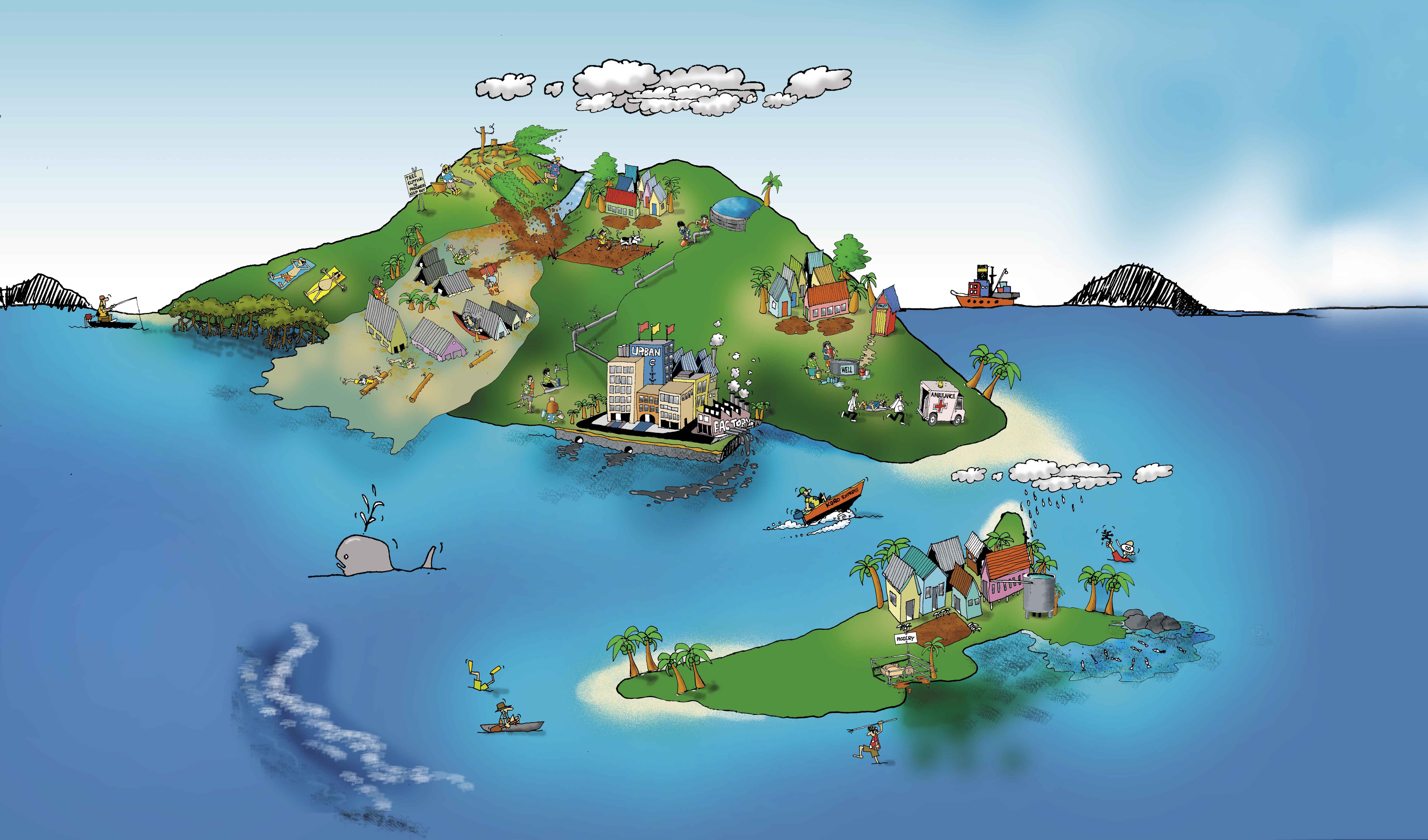






























Water is everybody's business
Water Supply Systems
Groundwater
Water and Health
Water reticulation systems collect, store and distribute
Groundwater is water that fi lters through the soil and
Clean drinking water, water for sanitation and water
IWRM - HOW WATER CONNECTS PEOPLE AND THEIR ENVIRONMENT
water to users. In less inhabited areas, the water supply
is stored in underground reservoirs called aquifers,
for food crops are all key to human health and
system may be on a household level, e.g. with a private
which provide water storage that is especially
survival. Water quality monitoring is needed to ensure
well or rainwater harvesting. More inhabited areas
important in times of drought when rain and surface
that water is safe and suffi cient to demands for
usually have a common water supply system (such
water is scarce. Volcanic islands hold groundwater
these uses. Storage and supply systems need to be
as reservoirs and pipelines or distribution by tankers)
effectively, while porous coral atolls often have little
maintained, and water sources protected, in order to
which is run by government, private companies or
or no groundwater.
prevent contamination of the water.
community organisations.
It is important to monitor rainfall, groundwater levels,
Water also needs to be used effi ciently to ensure
Installations for water supply need maintenance
water extraction and water quality in order to regulate
that there is enough water through times of water
and monitoring in order to avoid leakages and
extraction rights and to set up schemes for water use
scarcity (i.e. droughts). To enable this, users need to
contamination of the water, and it is important to plan
and conservation.
get involved and have a basic understanding not only
for how to recover these costs (e.g. through trust
of the importance of clean water to their health, but
funds or tariff systems).
Groundwater also needs to be protected from
also of the water cycle and the links between human
contamination seeping into the aquifers by setting
Water supply systems need to match water demand to
activities, the environment and water supply.
up water protection areas/reserves and taking action
availability, and therefore needs to ensure that water
against pollution from wastewater, run-off from dump
is used in an effi cient manner.
sites and other sources. If the groundwater quality is
not good enough for drinking, it may still be used for
sanitation and agricultural puposes.
Rainwater
As long as the levels of air pollution are low, rainwater
is one of the purest sources of water. It is a simple
system that can be run on individual household level,
and is especially important in areas where there is no
surface or groundwater available.
Rainwater harvesting requires investment in a
catchment area (e.g. a roof with guttering), tanks
for storage and a tap or pump for access. In order to
ensure safe and clean water, all these parts need to
be maintained and kept clean to ensure there are no
leakages or contamination of the water.
The water quality needs to be monitored to ensure
that it is safe for consumption. By measuring water
Watersheds
consumption in the household and with the help
of meteorological information on expected rainfall
pattern, it is possible to determine the appropriate size
A watershed or catchment is the total land area that
of rainwater harvesting catchment area and storage
contributes water to a river, stream or lake. Land-use
tanks in order to meet the water use demands of the
practices such as forestry, agriculture, hydropower
household.
plants and other developments can affect run-off of
water, soil and pollutants into rivers and streams.
This is especially important to do this in areas with a
variable climate, with long drought periods interspaced
If mismanaged this can lead to increased soil erosion,
with short periods of intense rainfall. In some cases
fl ooding events, contaminated human water supplies
it may be necessary to set up common emergency
and degraded freshwater and marine ecosystems (e.g.
reserves of rainwater to be used during droughts.
mangroves and coral reefs) resulting in reduction of
coastal defences and fi sheries decline. Management
therefore needs to refl ect linkages between upstream
activities and downstream effects (a "ridge-to-reef" or
Wastewater
"hilltops-to-oceans" approach).
Sewage, drainage, industrial effl uents, storm water,
run-off from agriculture containing pesticides,
Coastal & Marine Waters
fertilisers and animal waste, dissolved air pollution,
run-off from roads and urban areas, seepage from
Water run-off and seepage from land carries minerals,
dumps, liquid hazardous waste, and other types of
sediments and pollutants that impact on coastal
wastewater accumulate in streams and rivers, leak
ecosystems. Changes in run-off can come at a high
into aquifers, and wash out to sea.
cost to coastal communities, bringing contamination
If not properly treated, it can damage human health
of swimming waters, destruction of coastal and
by contaminating drinking water supplies and water
fl ooding defences, declining fi sheries, coastal erosion
environments used for washing, fi shing and swimming.
and loss of tourism revenue.
Untreated wastewater also provides an overload of
An increase in sediment and nutrients from land
nutrients that can threaten biodiversity and ecosystem
can pose a threat to reefs (smothering corals and
functions.
increasing algal growth) while a decrease in sediment
If properly treated, wastewater can be recycled for
outputs from rivers can lead to increased coastal
fl ushing toilets or watering plants, while sewage,
erosion and loss of mangroves. Mangroves also
human and agricultural waste can be used as fertilisers
depend on a specifi c river fl ow providing a balance
or to produce biogas.
between freshwater and saltwater. In some cases,
By ensuring that waste doesn't mix with water,
mangroves have been depleted due to changes
techniques such as composting and dry toilets save
in river fl ow, e.g. due to the installation hydropower
precious drinking water and prevent environmental
plants.
degradation.
Pen Knife 08
In order to address the effects of land-based
It is important to protect wetlands which act as
activities and pollution on the coastal environment
natural "treatment plants" and help reduce to impact
and resources it is therefore necessary to integrate
of wastewater.
coastal and water resources management.
How will the GEF-funded Pacifi c IWRM Project help?
WHEN? Preparation 2004-2007 and implementation 2008-2013 WHO? Executed by SOPAC with support from UNDP and UNEP, and funded by the Global Environment Facility (GEF)
HOW? By reviewing the water resources management status and needs in 14 pacifi c island countries and implementing activities to demonstrate how IWRM approaches can be used to address these issues
Cook Islands
Fiji
Activities: Protection of groundwater resources from pollution
Activities: Re-introduction of native plant species to help stabilise
Repair Maintenance of infrastructure for groundwater supply; Water
for the formulation and establishment of Water Safety, Water Use
through sanitation upgrading; Stress reduction of water resources
soil; Establish long-term low-cost monitoring program use of
resource use planning and monitoring using Geographic Information
Effi ciency and Watershed/Aquifer Protection Management Plans;
adoption of the National Integrated Water Resources Plan the Water
through conservation and improved water management; Capacity
bioindicators; Mitigation of road drainage; Survey pollutant sources;
System (GIS); establishment of a Laura Lens Integrated Water
Designation of an aquifer/well fi eld; Raising awareness and training
Resources Act and the Building Code; Strengthening the National
Environmental and socio-economic protection in Fiji:
Water and Sanitation Committee; Update baseline data on nutrient
Integrated freshwater and coastal management on
building and awareness; Improved planning and coordination
Surveying socio-economic importance of watershed; Etablish
Resource Plan
for IWRM
Integrated fl ood risk management in the Nadi River Basin
and pathogen contamination of groundwater; Funafuti community
Rarotonga Aims: To improve groundwater, freshwater and
"Payment for Ecosystem Services" scheme; Awareness raising on
Aims: To improve fl ood preparedness and integrate land and water
Niue
Samoa
Tonga
awareness raising on sanitation; Introduce technical and management
lagoon water quality using an IWRM framework and to gain
watershed protection
management planning within the Nadi Basin using an integrated
options for sanitation and water conservation.
information on the availability of groundwater for drought
fl ood management approach Activities: Improvement of rainfall
Papua New Guinea
relief. Activities: Technical assessment of water quality and
and hydrological events monitoring to improve fl ood forecasting;
Using integrated land use, water supply and wastewater
Rehabilitation and sustainable management of Apia
Improvement and Sustainable Management of Neiafu;
Vanuatu
quantity information measures; Knowledge dissemination to
Development of a Nadi Basin Catchment Committee and Flood
management as a protection model for the Alofi town
Catchment
Vava'u's Groundwater Resource
promote community knowledge and understanding; Institutional
Management Plan; Awareness raising on fl ooding resilience for local
groundwater supply and nearshore reef fi shery
Rehabilitation, management and monitoring of Laloki River
Aims: To rehabilitate and improve the quality and quantity of the
Aims: To ensure sustainable water resource management and
strengthening and human resource capability development
Sustainable Management of Sarakata Watershed
communities and other stakeholders.
Aims: To protect the Alofi groundwater, well fi eld and near shore
system for economical, social and environmental benefi ts
water resources of the Apia Catchment Activities: Review and
protection of the fragile Neiafu Groundwater Resources Activities:
measures
area from over-abstraction and land-based pollution through an IWRM
Aims:
Aims:
To promote the sustainable use of the water resources of
formulation of catchment policy and management plan to facilitate
To ensure sustainable management of the Sarakata watershed
Mitigation of threats to human health from contaminants focussing on
Kiribati
framework Activities: Improving management of hazardous waste,
Laloki catchment Activities: Establish a participatory mechanism
effective water conservation, allocation and service provision;
by formulating and implementing a land use management plan for the
Federated States of Micronesia
agricultural practices, land-use, liquid waste; Monitoring compliance
solid waste, wastewater to reduce run-off from industries, fi sheries
to support integrated catchment planning, management and
Conservation and rehabilitation of degraded areas to reduce water
watershed Activities: Participatory ecological and socio-economic
of the Water Resource Management Bill; Institutional strengthening
surveys, mapping and resource valuation; Establish watershed
processing, agriculture and roads; Awareness raising and planning
monitoring; Improve waste management and reduce human-induced
pollution; Land use monitoring; Ecotourism; Capacity building and
Kiribati will be supported through the regional component of the GEF-
and community awareness for water resources management and
management strategies, policies, plans and monitoring; Promotion of
Ridge to reef: protecting water quality from source
for water conservation and demand management; Establishment of
contamination; Develop site-specifi c water quality criteria; Establish a
public awareness for watershed management
funded IWRM project and will develop a national IWRM demonstration
monitoring; Development of a Water Resource Management Plan.
alternatives to de-forestation, agricultural and coastal management
to sea in the FSM Aims: To improve drinking water quality
groundwater protection zones; Hydrogeological and water quality
hydro-meteorological network for the catchment
project in due course.
Solomon Islands
practices; Establish community managed protected areas; Develop
and signifi cantly reduce pollutants entering fresh and marine
surveys for maintenance of well fi eld; Water policy and planning
Tuvalu
Republic of the Marshall Islands
and implement Water Safety Plans; Mitigate fl ooding; Manage
waters around Pohnpei Island and in Chuuk State Activities:
Nauru
Palau
watershed for sustainable hydro power.
Improvement of forest management and strengthening a
Managing Honiara City water supply and reducing pollution
Integrated Sustainable Wastewater Management (Ecosan)
Watershed Forest Reserve Area; Linking communities to create
Integrated water management and development plan for
through IWRM approaches
for Tuvalu
For more Information:
awareness on upstream to downstream impacts; Water quality
Enhancing water security for Nauru through better water
Ngerikiil watershed restoration for the improvement of
Laura groundwater lens, Majuro Atoll
Aims: To ensure sustainable water supply and wastewater services in
Aims: To ensure drought proofi ng and prevent sewage pollution of
monitoring programme; Assessment and mitigation of wastewater
management and reduced contamination of ground water
water quality
Aims: To improve water resources management, reduce groundwater
Honiara City Activities: Assessment of water abstraction, land-based
fresh and marine waters by reducing demand on primary drinking
Ulrika Gunnartz, James Dalton or Rhonda Robinson, SOPAC IWRM
and pollution sources; Development of a Water Safety Plan and a
Aims: To adopt a working and affordable system for sustainable
Aims: To reduce land degradation while preserving ecosystem
pollution and improve water supply around the Laura area Activities:
activities impacting water resources, water leakages and wastages
water supply for sanitation systems Activities: Review and
Programme, Phone: (679) 338 1377 Email: iwrm@sopac.org
Harbour Water Quality and Management Plan
integrated water resource and wastewater management in Nauru
stability, functions, and services of the Ngerikiil Watershed
Provision of wastewater, sanitation, solid waste and recycling facilities;
Web: www.sopac.org or www.pacifi cwater.org



IWRM in Pacifi c Island Countries
Integrated
Water Resources
Management
The Pacifi c Island Countries have
(IWRM)
started working at different stages
How are we doing?
of the IWRM process, whether it is
Considers all the
revising policy and legislation, forming
IWRM component
CI FSM FJ KI RMI NR NI PA PNG SA SI TO TV VA
interactions of water with
a water coordination committee,
Intersectoral water coordination body
nature and humans, along
developing a Water Safety Plan,
National water resources policy
its route from raindrop to
creating water protection areas or
ocean
Overarching water resources legislation
catchment management committees,
IWRM Plan/Strategy
raising awareness on water and
The Pacifi c Integrated
Recognises water as
Water Use Effi ciency Plan
health,
promoting
sustainable
a fi nite and vulnerable
alternatives for sanitation and
resource with an
Not existing
Draft/interim not formally adopted, functions outlined, fully intersectoral or proactive
wastewater, setting up hydrological
Water Resources
economic value
Formally adopted, fully intersectoral and active
monitoring programmes, or looking
Works towards balancing
at economic effi ciency of water
CI - Cook Islands, FSM - Federated States of Micronesia, FJ - Fiji, KI - Kiribati, RMI - Republic of Marshall Islands, NR - Nauru,
use. The EU-funded IWRM National
NI - Niue, PA - Palau, PNG - Papua New Guinea, SA - Samoa, SI - Solomon Islands, TO - Tonga, TV - Tuvalu, VA - Vanuatu
Management Programme
water demands for
environment, human
Planning Programme will support the
health and economic
different countries based on their
development, to ensure
specifi c situation and needs.
optimal, equitable and
sustainable use
Brings together
stakeholders from different
Challenges and opportunities for Water Governance
sectors and social groups,
to plan and manage water
Kiribati, Fiji and the Solomon Islands were chosen to pilot governance processes for intergrated and sustainable water management with support
in a coordinated, gender
from the regional Programme for Water Governance (PfWG) funded through the European Union (2005-2007).
balanced and participatory
The programme helped the three countries to initiate a process for effective water governance.
manner
Through the PfWG process, Fiji developed a draft water policy and a draft Water Resources Act.
Fiji also formed a National Water Committee and formulated a draft strategy to support the
IWRM process. The Cabinet has since adopted the draft Policy as Interim, subject to an ongoing
consultation process. The future IWRM process in Fiji will need to raise awareness and under-
standing of IWRM to ensure political commitment to dealing with complex issues such as water
ownership. There is a risk that urgent issues such as fl ooding and access to water supplies will
`take over' overarching policy processes, resulting in a disjointed and fragmented approach to
the resource and its management, and a lack of attention to the interconnected nature of land
and water.
Fiji
The Solomon Islands has faced periods of political instability, which has made it diffi cult to focus
government attention on a single issue such as water. Water resources management has been
fragmented due to a lack of national policy and community awareness. Through the PfWG, key
government representatives got the chance to exchange experiences with Samoa, which has already
come far in the process of improving water governance. Solomon Islands drafted a National Water
Resources Policy and a National Water Resources Legislation, formed a temporary water group
and drafted terms of reference for a National Steering Committee to support the IWRM process.
The government has provided a budget allocation for the IWRM process and are currently focusing
on consultation and review of the National Water Resources Act. Solomon Islands are faced with
challenges such as resolving water ownership issues (especially in the view of increased mining
What? The Pacifi c Integrated Water Resources Management (IWRM) Programme will assist Pacifi c Island
activities) and raising awareness of water resources management (specifi cally links to land-use
practices) taking into account low literacy rates in communities.
Solomons
Countries to establish and implement effective IWRM and Water Use Effi ciency (WUE) plans based on best
practices and demonstrations.
It consists of two main projects: 1) The EU funded "IWRM National Planning Programme" and 2) the GEF
funded "Sustainable Integrated Water Resources and Wastewater Management Project in Pacifi c Island
The main challenges to IWRM identifi ed for Kiribati include politicised resource management
Countries" (Pacifi c IWRM Project)
approaches, lack of government awareness and political will, and the dispersed nature of the
Where? Cook Islands, Federated States of Micronesia, Fiji, Kiribati, Marshall Islands, Nauru, Niue, Palau,
land and population; all leading to delay in adoption of draft national water plans, policies and
Papua New Guinea, Samoa, Solomon Islands, Tonga, Tuvalu, Vanuatu
legislation. This was partly addressed by supporting the reformation of the Kiribati Water Supply
and Sanitation Coordinating Committee under the Offi ce of the President to avoid intersectoral
Why? To help Pacifi c Island Countries:
competition. It was also recognised that capacity needs to be built in a wide range of areas
· Balance confl icting uses of scarce freshwater resources
supporting IWRM; from policy making to technical expertise and community participation
in decision-making. The challenge of geography could be met by grouping the islands in
· Improve public and environmental health by ensuring consistent water availability and quality
governance arrangements. The progress toward IWRM will be infl uenced by the means and
· Reduce effects of soil erosion, inadequate sanitation and other harmful activities on the quality of fresh and
success in coordinating the various Ministries, agencies, and departments involved. The IWRM
coastal waters
Kiribati
process needs to account for, and be adapted to, the cultural circumstance of Kiribati.
· Reduce vulnerability to droughts, fl oods, landslides and pollution
· Implement the seventh Millennium Development Goal (www.un.org/millenniumgoals/) on environmental
For more information contact: Ulrika Gunnartz, James Dalton or Rhonda Robinson, Project Advisers for the IWRM Programme
sustainability including the aim "all countries to develop Integrated Water Resources Management and Water
SOPAC Secretariat, Private Mail Bag, GPO, Suva, Fiji, Tel: (679) 338 1377, Fax: (679) 337 0040, Email:iwrm@sopac.org
Use Effi ciency plans by 2005" and the Pacifi c Regional Action Plan on Sustainable Water Management
Web: www.pacifi cwater.org or www.sopac.org
endorsed by the governments of 14 Pacifi c Island Countries